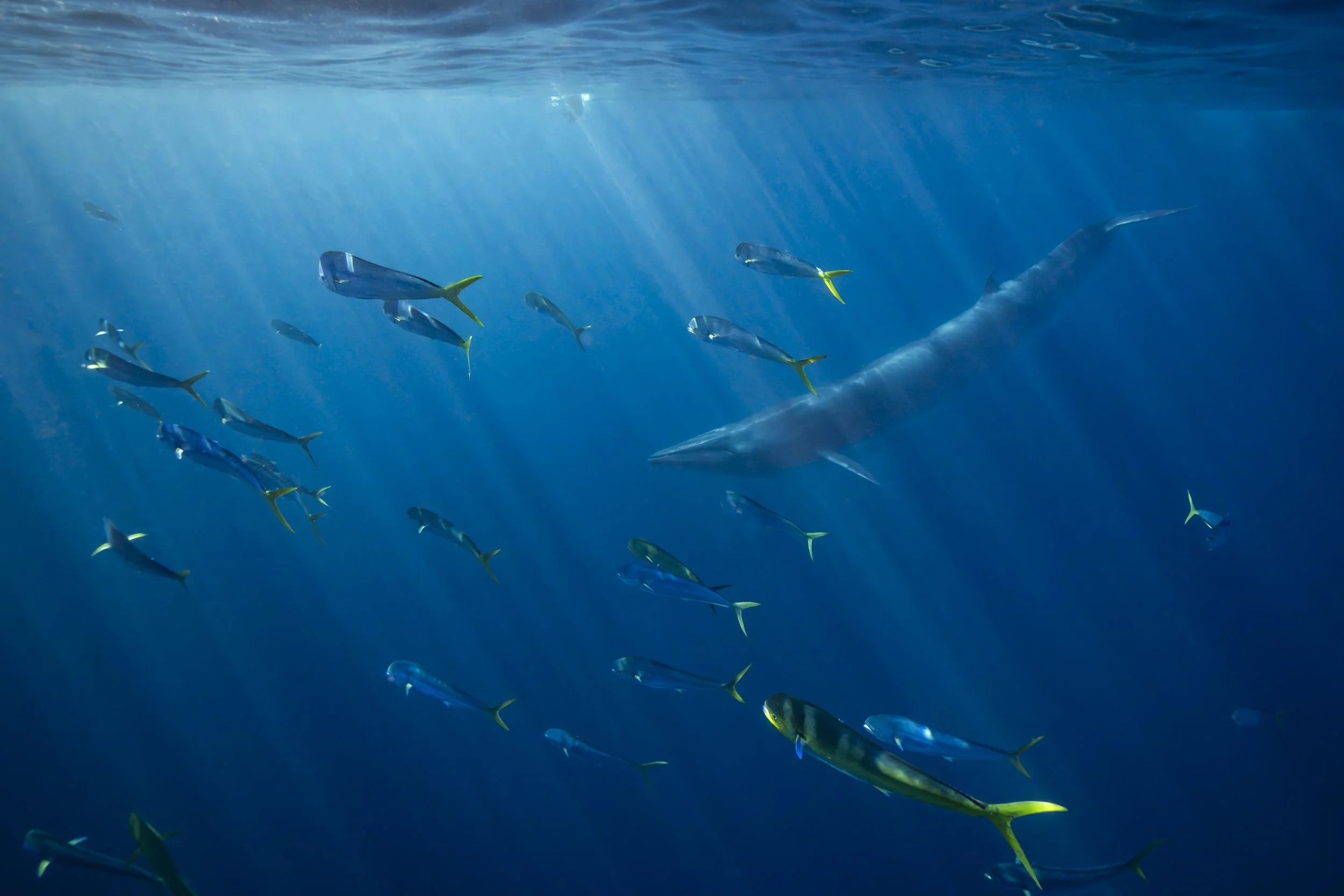
Last year in Magdalena Bay things took a bit of a turn for the unexpected. It being an El Niño year, we experienced much warmer water temperatures than are typical in the Pacific in November and December, and this brought changes in the dominant predators to the bait balls than we have seen in years past. There were significantly less marlin than we are used to, replaced by an overwhelming number of Mahi-Mahi, the usual sea lions, and tons of Bryde’s Whales. This used to be more of a unicorn encounter; when you’re lucky enough to be on the right bait ball at the right time and all of sudden whoosh, in comes a Bryde’s Whale mouth agape and swallows the bulk of the ball in one go. Without the dominance of the marlin, the whales took advantage, and we were treated to this spectacular spectacle numerous times throughout the season. In addition to the Bryde’s Whales, one clever humpback whale caught on, and we witnessed what may be the first documented incident of a humpback whale feeding in Baja California. Photo by Luke Coley on a Latitude Expedition
Latitude’s inaugural international trip brought us to the beautiful Caribbean paradise of Dominica, renowned for towering waterfalls, fragrant spices, and resident sperm whales! Fer led 2 groups over 10 days of amazing blue water encounters with the largest toothed whale, often in family units of females and juveniles. We witnessed the whales displaying their incredibly endearing social behaviors as well as the holy grail of sperm whale displays; sleeping in a completely static vertical position. Though most of our days on the water were lucky with the cachalots, we did run into several days when they were a bit too far out of range, and their distance was most likely due to the presence of another toothed cetacean, the short-finned pilot whale. Though there is no documented evidence of actually predation of sperm whale calves, there have been several accounts of aggression on sperm whales by pilot whales, and the sperm whales acting defensively particularly when they have calves amongst them. Their distrust of one another as a species more likely stems from competition for food, as both primary eat squid in extreme depths. Pilot whales are known as the “cheetahs of the sea” for their speedy hunting techniques and evolved team strategies. Like their sperm whale rivals, they make long deep dives in search of food, and then need ample rest on the surface to digest and oxygenate. We were lucky enough to encounter a group of 30+ individuals doing just this, resting almost stationary on the surface, and making subtle clicks to maintain themselves as a group, only moving or diving when the signal was communicated. We were able to stay with them for hours in the crystal clear blue Caribbean waters; an unforgettable ending to our first of hopefully many expeditions abroad. We have ONE remaining spot for 2025’s Dominica trip, don’t snooze on this it is a trip of a lifetime! More information here.

Our Mobula & Megafauna season in La Ventana is definitely a highlight of the year. The East Cape provides a stunning backdrop for the incredible ocean activity that can occur in the Sea of Cortez, and the variety of encounters is unbeatable. Our resident Marine Biologist and Guide Dr. Katy had a truly spectacular encounter this season, so much so that is has inspired a new scientific paper that will be released later this year (stay tuned!) Katy, Cano (our trusted La Ventana captain), and her group had come across a pod of five orcas, which normally is enough to make a trip great on its own. However these orcas had other plans to further blow minds outside of their standard awesomeness. They proceeded to locate and hunt a juvenile whaleshark, taking turns bashing into the shark to invert it into a catatonic state. Ultimately they went first for the sharks liver, the most nutritionally dense organ, and then proceeded to share in the feast for the whole pod. Katy and her group managed to have front row seats to the whole show, with Cano’s help tracking the whaleshark from the surface. Katy has previously published a paper on orca predation on Bullsharks and Black Tip sharks in Cabo Pulmo (read it here!), and this encounter is a huge step in helping us further understand Baja’s killer whales.
The Silky Shark aggregation around Los Cabos was incredible this year; warmer waters in the winter brought them in earlier to mate, but luckily for us they stuck around all summer long. Late July we went out for a normal shark safari, and were greeted with abundant silky sharks quickly into our chumming. We were having a great time with the silkies when all of a sudden, a curious killer whale decided to come investigate what we were up to with all these sharks! It swam right to our chum box, had a sniff, and carried on it’s way. As you can see in the photos below this was a crazy moment we just barely managed to capture, but will never forget. Needless to say we opted to leave the sharks and see what these curious orca were up to, and we discovered them in pursuit of an oceanic sunfish or Mola Mola, one of their favorite meals around Baja for their size as the largest bony fish and their speed (or lack thereof). One orca was gently nudging the Mola Mola when out of the blue another speeds in and blam! whacks the fish into oblivion with it’s pure velocity. This was an absolutely insane encounter taking place right on our home turf of Los Cabos, and a great way to end our 2024 season on an incredible high!